Crypto Without the Chaos: How AI Portfolio Managers Are Redefining What It Means to Be an Investor
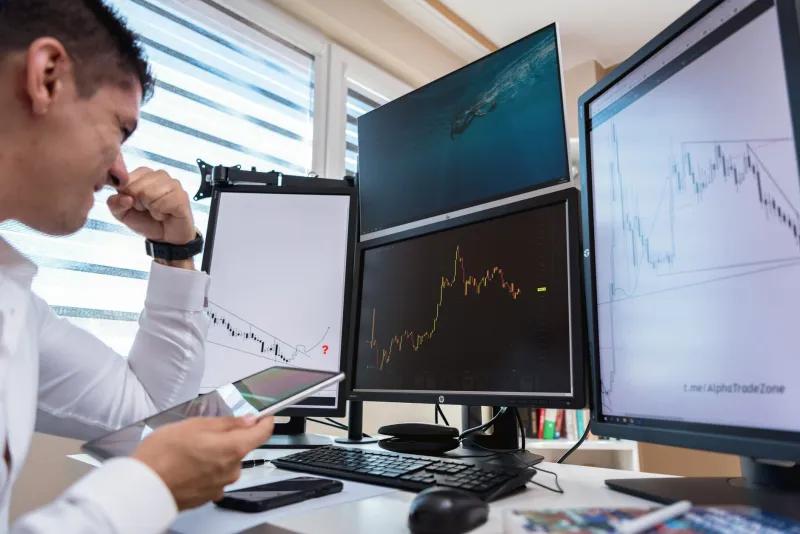
There is a persistent mythology surrounding cryptocurrency investing in the United States: that the only traders who profit are those glued to multiple monitors, consuming live order book data at midnight, and reacting to every market fluctuation within seconds. This image — equal parts glamorous and exhausting — has discouraged countless professionals from participating meaningfully in digital asset markets.
The reality in 2025 looks considerably different. AI-powered portfolio management platforms are systematically dismantling the "always online" requirement, offering a credible alternative for investors whose careers, families, and lives demand their attention elsewhere. Understanding what these tools actually deliver — and where they still fall short — is essential before committing capital to any automated system.
The Core Problem With Active Day Trading
Before examining the AI solution, it is worth acknowledging why human active trading so frequently underperforms. Research consistently demonstrates that the majority of retail day traders lose money over meaningful time horizons. The reasons are structural: emotional decision-making during volatility, inconsistent strategy execution, cognitive fatigue during extended sessions, and the near-impossibility of maintaining disciplined risk management when markets move against a position at 3 a.m.
Crypto markets compound every one of these challenges. Unlike equity markets, which close at 4 p.m. Eastern, digital asset exchanges operate continuously across every time zone. A meaningful price dislocation can occur during a Tuesday afternoon work meeting, a family dinner, or simply during sleep. No individual investor can monitor all of this without cost — either financial, through missed opportunities, or personal, through burnout and deteriorating judgment.
AI portfolio managers are designed specifically to absorb this burden.
What AI Portfolio Management Actually Does
Modern AI-driven portfolio tools operate across several distinct functions that collectively replicate — and in some dimensions exceed — what an attentive human trader might accomplish.
Automated rebalancing is perhaps the most immediately practical feature. An investor defines a target allocation — say, 50% Bitcoin, 30% Ethereum, and 20% distributed across select altcoins — and the system continuously monitors drift from those targets. When market movements push allocations outside predefined thresholds, the platform executes corrective trades without requiring human input. This enforces a discipline that most active traders struggle to maintain emotionally.
Rule-based execution removes the single greatest enemy of retail trading performance: emotion. AI systems do not hesitate when a stop-loss triggers on a position they have held for three months. They do not chase a momentum trade because social media sentiment is surging. Parameters are set in advance, during calm and rational conditions, and executed precisely when triggered — regardless of the psychological pressure a human would feel in that same moment.
Continuous monitoring with conditional alerts means the system watches for defined conditions around the clock and either acts automatically or notifies the investor only when meaningful intervention is warranted. Rather than monitoring markets constantly, a busy professional might receive a handful of relevant alerts per week — each representing a genuine decision point rather than noise.
Where Set-and-Forget Systems Genuinely Outperform
The evidence for automated systems is most compelling in range-bound or gradually trending markets — conditions that describe a substantial portion of crypto trading environments. In these periods, disciplined rebalancing and systematic position sizing consistently outperform reactive human trading, primarily because they avoid the costly errors of overtrading and emotional repositioning.
Long-term dollar-cost averaging strategies, when automated through AI platforms, also demonstrate a meaningful edge. The system purchases at regular intervals regardless of short-term price action, smoothing entry costs over time. Human investors attempting the same strategy frequently deviate — pausing purchases during downturns out of fear, or accelerating them during rallies out of excitement — undermining the very discipline the strategy requires.
For professionals with demanding schedules — physicians, attorneys, small business owners, and corporate executives represent a significant segment of crypto investors in the U.S. — the time savings alone represent measurable value. An investor who would otherwise spend fifteen hours per week monitoring positions and executing trades can redirect that time while the AI manages execution within their defined parameters.
The Honest Limitations That Every Investor Must Understand
No responsible discussion of AI portfolio management omits its genuine limitations, and any platform that fails to acknowledge them warrants skepticism.
AI systems are backward-looking by design. They are trained on historical data and optimized for patterns that have previously occurred. When market conditions shift structurally — a new regulatory framework, an unprecedented macroeconomic shock, or a technological disruption within the blockchain ecosystem itself — the model's prior training may become a liability rather than an asset. The system will continue executing its programmed logic even as that logic becomes increasingly misaligned with current conditions.
Parameter configuration remains a human responsibility, and it is a meaningful one. An AI portfolio manager is only as sound as the instructions it receives. Poorly defined risk thresholds, inadequately tested rebalancing triggers, or an asset allocation that was never appropriate for the investor's actual risk tolerance will all be executed faithfully and efficiently — producing poor outcomes at scale. The automation amplifies both good decisions and bad ones.
Platform risk also deserves serious consideration. Delegating portfolio management to a third-party AI service introduces counterparty exposure that direct custody does not. Investors should scrutinize the security architecture, custody arrangements, and regulatory standing of any platform before connecting it to live assets.
Finally, genuinely extraordinary market events — sudden exchange failures, coordinated regulatory actions, or black swan price dislocations — can move faster than any automated system's response parameters are designed to handle. These are rare, but their consequences can be severe.
Building a Practical Framework for the Time-Constrained Investor
For professionals seeking a workable approach, a tiered framework tends to produce the most defensible outcomes.
Begin by establishing clear investment objectives and risk parameters independently of any platform. What is the target allocation? What drawdown is genuinely tolerable? What time horizon governs these decisions? These answers should precede any platform selection.
Select AI tools that offer transparent logic — systems where the investor can understand and audit the rules being applied, rather than opaque black-box models. Explainability is not merely a comfort feature; it is essential for identifying when a system's behavior has diverged from the investor's intent.
Maintain a regular review cadence even when active monitoring is not required. A monthly review of system performance, allocation drift, and market context takes far less time than daily trading — but it ensures the investor remains an informed principal rather than a passive bystander.
Finally, preserve a meaningful cash or stablecoin reserve outside of the automated system. This provides both a buffer against forced liquidation during volatility and the optionality to act independently if market conditions warrant a judgment call the algorithm cannot make.
A More Realistic Definition of Crypto Participation
The fifteen-minute investor is not a myth — but they are not entirely passive either. AI portfolio management tools genuinely compress the time requirement for informed crypto participation, removing the operational burden of continuous monitoring while enforcing the disciplined execution that most human traders fail to sustain.
What they cannot do is replace informed judgment about objectives, risk tolerance, and the evolving landscape of digital assets. The most effective use of these tools positions AI as a capable executor of a human-defined strategy — not as a substitute for having a sound strategy in the first place.
For the busy professional who has kept crypto at arm's length precisely because the time commitment seemed prohibitive, the current generation of AI portfolio tools represents a genuine inflection point. The barrier was never really the technology. It was the assumption that investing required constant presence. That assumption is no longer accurate.