MEV Predators Are Draining Your Trades — Here Is How AI Fights Back
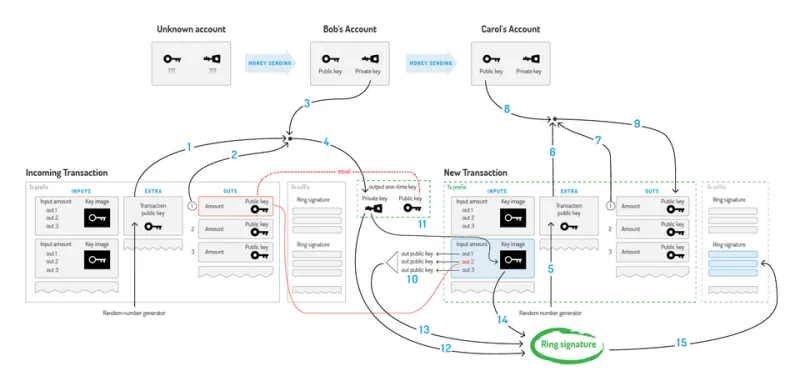
Photo: CryptoNote official site, CC BY-SA 3.0, via Wikimedia Commons
If you have ever placed a trade on a decentralized exchange and walked away feeling like you paid slightly more than you should have, there is a reasonable chance you were not imagining it. Maximal Extractable Value, or MEV, is the technical term for the profit that sophisticated actors extract by manipulating the order in which blockchain transactions are processed. The sandwich attack is the most common expression of this exploitation, and it costs retail traders on Ethereum and other EVM-compatible chains an estimated hundreds of millions of dollars annually.
The mechanics are straightforward, even if the execution is technically demanding. A bot detects your pending transaction in the public mempool — that waiting room where unconfirmed trades sit before miners or validators include them in a block. The bot then places one transaction immediately before yours, driving the price up, and another immediately after, selling into the slippage your trade just created. You absorb the loss. The bot pockets the difference. The entire sequence can unfold in milliseconds.
For years, retail traders had limited recourse. Set tight slippage tolerances and risk your transaction failing entirely. Use private transaction relays and hope the counterparty is trustworthy. Or simply accept the cost as a tax on decentralized trading. Increasingly, however, AI-powered detection and defense systems are changing that calculus.
What the Mempool Actually Reveals
The mempool is, in a sense, a goldmine of behavioral data. Every pending transaction broadcasts its intent — what asset is being traded, at what size, with what gas price attached. MEV bots have been reading this data and acting on it algorithmically for years. The insight behind modern AI-based protection is that if bots can read those signals, machine learning systems can read them too — and faster.
AI monitoring tools trained on historical MEV attack data can identify the characteristic signatures of sandwich setups as they form. These include abnormal gas price clustering around specific pending transactions, rapid sequential submissions from known bot addresses, and liquidity pool price impact calculations that suggest a profitable extraction window. Rather than reacting after the fact, these systems flag risk in the microseconds before block inclusion.
Some platforms go further, analyzing wallet behavioral patterns over time. If a particular address consistently appears within one or two positions of large retail swaps, that pattern becomes a training signal. The model learns to weight the presence of that address as a probabilistic threat indicator, not just a coincidence.
Real-Time Defense Versus Post-Hoc Awareness
Not all AI tools in this space are doing the same thing, and the distinction matters considerably for traders who are actually trying to protect capital.
The first category is detection-and-alert tooling. These platforms — several of which have emerged from the Ethereum research community and are now available to US retail users — monitor your wallet's pending transactions and surface MEV risk scores in real time. They will tell you that your current swap has a high probability of being sandwiched based on current mempool conditions. What they do not do is intervene. The decision to proceed, cancel, or reroute the transaction remains with you.
The second category is active routing protection. These tools integrate directly with your transaction flow, typically by submitting your transactions through private mempools or MEV-resistant relays such as Flashbots Protect or similar infrastructure. Because your transaction never enters the public mempool, bots cannot see it in time to construct a sandwich. AI components in these systems handle the routing logic, selecting optimal relay paths based on current network conditions and historical success rates.
The third category — and the one that warrants the most scrutiny — is the growing number of wallet interfaces and DEX aggregators claiming broad MEV protection without being transparent about their methodology. Before trusting any platform's protection claims, traders should ask specific questions: Does the tool route through a private mempool? What is the relay's historical inclusion rate? Is the AI component auditable, or is it a black-box marketing feature?
The Indicators AI Systems Actually Monitor
For traders who want to understand the technical foundation of these tools rather than simply trusting a dashboard, several key signal categories are worth knowing.
Gas price anomalies are among the most reliable early indicators. When a bot prepares to front-run a transaction, it must submit its own transaction with a marginally higher gas price to ensure priority ordering. AI models trained on thousands of documented sandwich attacks have learned to recognize the specific gas price differentials that precede exploitation versus those that reflect normal network congestion.
Pool liquidity depth relative to trade size is another critical variable. Sandwich attacks are most profitable when a trade is large enough to move the price meaningfully but not so large that the attacker cannot profitably exit. AI systems calculate this ratio dynamically, flagging trades that fall within historically exploitable size bands for a given liquidity pool.
Address reputation scoring involves maintaining and continuously updating a database of known MEV bot addresses. While sophisticated bots rotate addresses regularly, many reuse infrastructure in detectable ways. Machine learning models that analyze on-chain interaction graphs can identify probable bot clusters even when individual addresses are new.
What These Tools Cannot Guarantee
Honesty requires acknowledging the limits of current AI defenses. No detection system eliminates MEV risk entirely. Private mempools can experience inclusion delays during periods of high network activity, which introduces its own trade execution risks. Some MEV extraction occurs at the validator level and is structurally invisible to mempool-monitoring tools.
There is also the question of false positives. Overly sensitive AI models may flag legitimate large trades or unusual but benign gas configurations as high-risk, causing traders to cancel or reroute transactions unnecessarily. The cost of that friction — missed trades, higher fees from alternative routing — is real, even if harder to quantify than direct sandwich losses.
Practical Steps for US Retail Traders
For traders operating on Ethereum mainnet or other EVM chains, integrating MEV protection into your workflow does not require deep technical expertise. Start by replacing your default RPC endpoint with a MEV-resistant alternative. Flashbots Protect is free to use and requires only a simple settings change in your wallet. For traders using DEX aggregators, verify whether the platform defaults to private transaction submission or requires you to opt in explicitly.
For larger trades — generally anything above five figures in value — consider cross-referencing a mempool monitoring tool before submitting. Several reputable platforms offer free-tier access that provides meaningful risk scoring without a subscription commitment.
The broader principle is situational awareness. AI tools in this space are most valuable not as a complete shield but as a means of making informed decisions. Understanding when your transaction is particularly vulnerable, and having the routing infrastructure to respond, is a meaningful edge in an environment where sophisticated actors are working continuously to extract value from retail activity.
The predators are algorithmic. Increasingly, so is the defense.