Portfolio Drift Is Quietly Undermining Your Crypto Strategy — AI Rebalancing Can Stop It
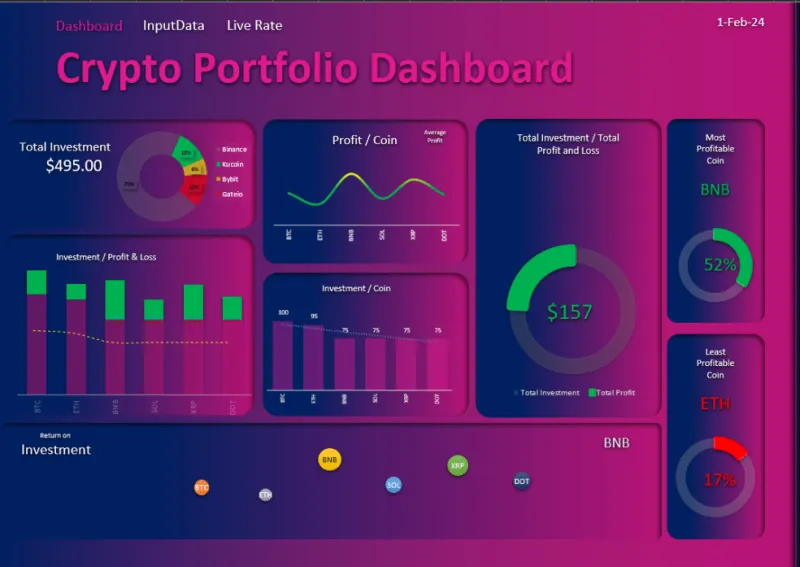
Photo: crypto portfolio balance digital asset allocation strategy dashboard, via file.eloquens.com
Imagine constructing a careful allocation across Bitcoin, Ethereum, and a selection of altcoins—say, 50% BTC, 30% ETH, and 20% distributed across a handful of emerging assets. You have thought through the risk profile. You understand the thesis behind each position. The strategy reflects your actual financial goals.
Now imagine returning to that portfolio six months later to discover that Bitcoin's rally has pushed your BTC allocation to 71%, your altcoin exposure has shrunk to near irrelevance, and the diversification you built in has been almost entirely undone by market movement you never consciously chose.
This is portfolio drift. It is one of the most common and least discussed risks in crypto investing, and for most US retail investors, it operates entirely below the threshold of active attention—until the consequences become impossible to ignore.
Understanding Drift: More Than a Minor Inconvenience
In traditional finance, portfolio drift is a well-documented phenomenon. Equity-heavy investors who neglected rebalancing during the 2017–2021 bull market found themselves dangerously overexposed to growth stocks when valuations corrected. The same structural dynamic applies in crypto, but with significantly amplified volatility.
Drift occurs when individual assets within a portfolio appreciate or depreciate at different rates, gradually shifting the actual allocation away from the intended one. In a market as volatile as cryptocurrency, meaningful drift can develop within weeks rather than the months or years it might take in a traditional equity portfolio.
The consequences extend beyond simple misalignment. An investor whose Bitcoin position has grown from 50% to 70% of their portfolio has, without making any deliberate decision, taken on substantially more concentration risk. If Bitcoin corrects sharply, the portfolio absorbs a loss far larger than the original strategy was designed to tolerate. Conversely, an investor whose altcoin exposure has ballooned due to a speculative rally may be holding far more risk than they realize—risk that is not visible until the market reverses.
Why Most Traders Ignore Drift Until It Is Too Late
The psychological explanation for drift neglect is not complicated. When a portfolio is performing well, the asset that has grown disproportionately is, by definition, the one that has been winning. Reducing it feels counterintuitive—even punitive. Investors experience a cognitive conflict between their original strategy and the emotional satisfaction of holding a position that is working.
This conflict is compounded by the effort required to rebalance manually. Calculating current allocations, determining the correct trades to restore target weights, executing those trades across potentially multiple wallets or exchanges, and accounting for tax implications—the friction is real, and it accumulates into inaction.
The result is a familiar pattern: an investor maintains a drifted portfolio through a bull market, enjoys the outsized gains from their largest position, and then experiences an equally outsized loss when that position corrects. The original diversification strategy, which was designed precisely to moderate that kind of concentrated drawdown, had long since ceased to exist.
How AI Drift Detection Works
AI-powered portfolio management tools approach drift detection as a continuous monitoring problem rather than a periodic review task. Where a human investor might check their allocations monthly—or less—an algorithmic system evaluates the portfolio against its target weights in real time, flagging deviation the moment it crosses a defined threshold.
The underlying mechanics involve several components that work in concert.
Threshold-based alerting. The most fundamental function is straightforward: the system continuously compares actual allocation percentages to target percentages and triggers an alert when the gap exceeds a defined tolerance—commonly set between 3% and 10% depending on the investor's rebalancing preference.
Drift trajectory modeling. More sophisticated systems do not merely report current drift; they project its trajectory. By analyzing recent price momentum and correlation patterns, AI models can estimate how quickly a current misalignment is likely to worsen, allowing investors to act proactively rather than reactively.
Tax-aware rebalancing recommendations. For US investors, rebalancing has tax implications that must be factored into any recommendation. AI tools that integrate tax-lot tracking can suggest rebalancing strategies that restore target allocations while minimizing taxable events—for instance, by directing new capital contributions toward underweight assets rather than selling overweight ones.
Emotional friction reduction. Perhaps the least quantifiable but most practically significant function of AI rebalancing tools is the removal of decision-making from a context where emotion typically distorts judgment. When a system flags a rebalancing need and presents a specific, calculated recommendation, the investor's role shifts from deciding whether to act to simply confirming an action that the data has already justified.
Real Scenarios Where Algorithmic Rebalancing Outperformed Manual Management
The performance data on systematic rebalancing versus passive drift management in crypto markets is instructive, though it requires careful interpretation.
During the 2021 bull market, portfolios that were algorithmically rebalanced at regular intervals—trimming Bitcoin and Ethereum exposure as their prices climbed and redistributing to underweight assets—consistently captured gains across a broader range of assets than portfolios that were left to drift. The rebalanced portfolios also experienced smaller peak-to-trough drawdowns during the subsequent 2022 correction, precisely because their concentration in the highest-flying assets had been systematically reduced.
Conversely, in sustained bull markets with strong single-asset dominance, unconstrained drift can temporarily outperform a rebalanced portfolio by maintaining concentrated exposure to the leading asset. This is the legitimate counterargument to automatic rebalancing, and it is one that honest AI tools should surface rather than suppress. The relevant question is not whether rebalancing always outperforms drift, but whether the risk-adjusted outcome of systematic rebalancing aligns better with the investor's actual goals and risk tolerance.
Choosing Between Human Discipline and AI Automation
The binary framing of human versus algorithmic management is somewhat artificial in practice. The most effective approach for most US crypto investors is a hybrid: AI tools that monitor for drift and generate rebalancing recommendations, with the investor retaining final approval authority.
This model preserves the speed and objectivity advantages of algorithmic monitoring while allowing the investor to incorporate context that a model may not fully capture—a conviction view on a specific asset, an anticipated tax event, or a deliberate tactical shift in strategy.
For investors who prefer full automation, several platforms now offer algorithmic rebalancing that executes without manual intervention once parameters are configured. This approach is best suited to investors with clearly defined, rules-based strategies who have determined that their own behavioral tendencies represent a net risk to their portfolio outcomes.
For those who prefer to retain discretion, the value of AI drift detection lies primarily in the monitoring and alerting functions—ensuring that drift never reaches the point of silent, damaging misalignment before the investor becomes aware of it.
Building Drift Awareness Into Your Process
Regardless of which tools an investor chooses, the foundational step is the same: define a target allocation explicitly, document it, and commit to a rebalancing policy before market conditions create emotional pressure to deviate.
From that foundation, AI drift detection tools serve as the early warning system that keeps the strategy honest. In a market that moves as quickly and unpredictably as cryptocurrency, the distance between a well-constructed portfolio and an unrecognizable one can close faster than any manual review process is designed to catch.
The investors who will navigate that reality most effectively are those who treat drift not as an incidental side effect of market movement, but as a structural risk that demands systematic attention—and who equip themselves accordingly.